By Malaika Rehman, Student Staff | Communications
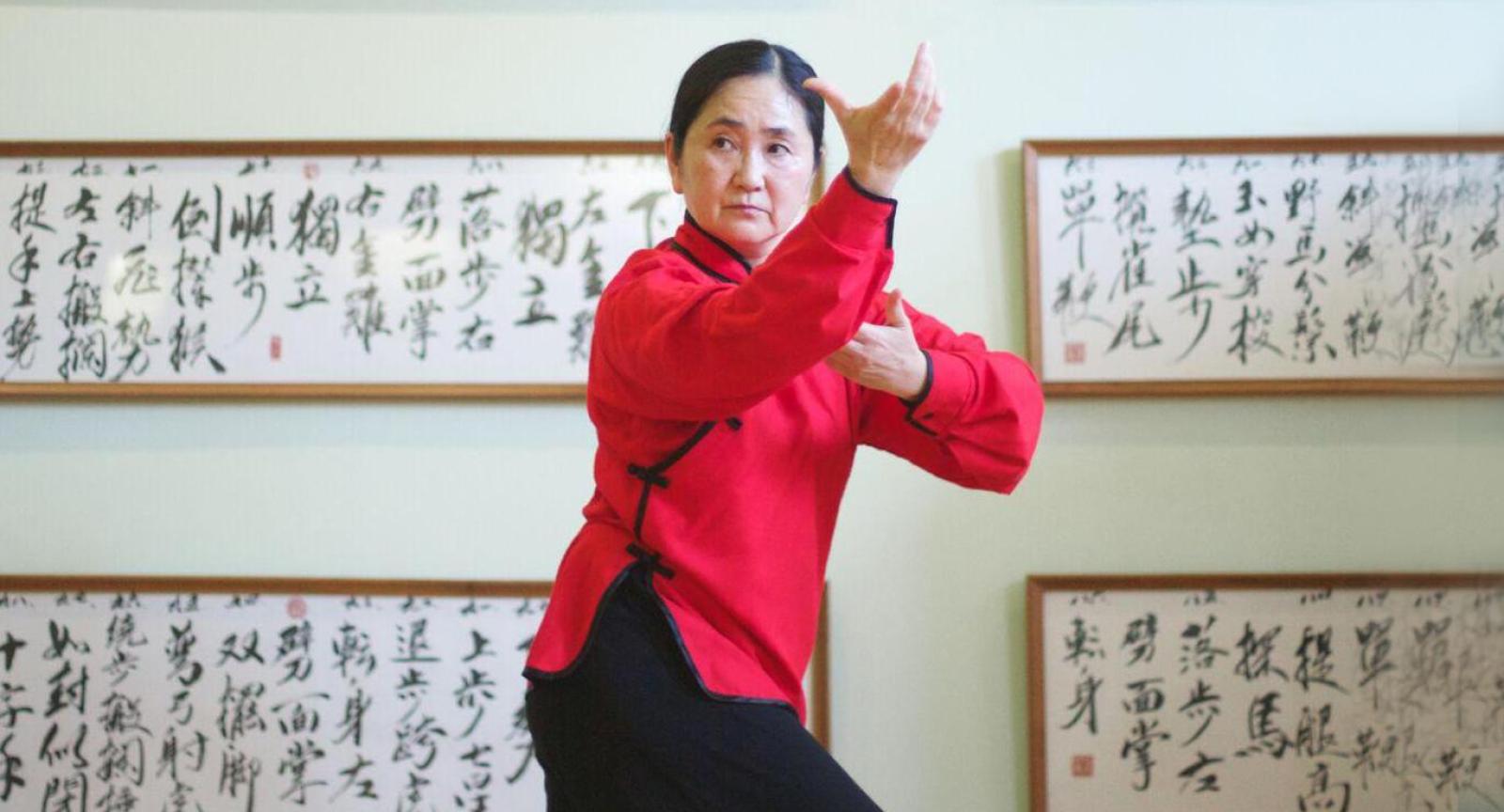
For most college students and other adults as well, days can feel overwhelming with pressing deadlines, social pressures, and the relentless pace and disruptions of a changing world. Here at UVA, the Contemplative Sciences Center offers opportunities to find peace and restoration through the centuries-old practices of T’ai Chi and Qi Gong. Each week, Master Hiromi Johnson teaches these classes during Friday Rest Fest, offering students and all adults alike a chance to slow down and rediscover a sense of groundedness that can otherwise feel out of reach.
Johnson, who is also the founder and director of the Charlottesville T'ai Chi Center, notes that while T’ai Chi began as a martial art, it's also the perfect activity to decompress, especially for students.
“I think it helps a lot for them, because they are stressed out, especially before exams,” Johnson said. “I’ve heard some students come and say: ‘Hiromi, I feel so relaxed now, and I can focus.’ ”
T’ai Chi, a form of Qi Gong, is a practice that weaves together slow, flowing body movements with balance and breath. It combines movements that help stretch muscles with the goal of becoming more physically resilient, while also allowing practitioners to meditate by focusing on their breath. While T’ai Chi is made up of more complex sequences that require memorization, Qi Gong follows a simpler routine. Both practices aim to promote Qi, or “life-force energy,” the energy that sustains life.
Johnson’s relationship with T’ai Chi began as a young girl in Japan. Growing up, she dealt with significant physical challenges, including two knee surgeries, the first at the age of 12 and the second at 16. Worried about her limited mobility, Johnson’s parents found her a local T’ai Chi instructor, and it was through this practice that she began to feel the power of the movement.
“I started to take the class there, and [started] to have good mobility,” Johnson said. “And then I started to feel that [the] meditation part of it was really helping me, because I was so disappointed about my situation, and then I started to have more courage and [wanted] to try more.
Even when her first instructor disappeared suddenly, closing the studio without notice, Johnson continued practicing on her own. Years later, while working as a fashion journalist in the city of Roppongi, she met another instructor, purely by chance.
“I found this health food restaurant near my office, and the owner was also a T’ai Chi instructor... at this time, I was still looking for an instructor after my first one left,” Johnson said. “One day, as I was eating, he came over to me and said, ‘I think you need to practice T’ai Chi,’ ...This is destiny, I thought.”
After moving to the United States in 1998, she joined a T’ai Chi club, where she was invited to demonstrate a form, the sequence of moves within the practice, which led to her first teaching opportunity.
“When the people in the club learned that I practiced T’ai Chi in Japan, they asked me to show them the routine.” Johnson said. “After that, people came to me and said they wanted to learn the form. And so, I joined that nonprofit group as an instructor.”
Today, Johnson grounds her classes in three pillars: the martial art aspect that speaks to the practices’ origins, the medicinal aspect which supports physical healing, and the meditative aspect that helps cultivate inner calmness.
For students navigating the demands of college life, Johnson’s class has become a space for refuge. For fourth-year Engineering student Stefan Calin, that sense of refuge is what keeps him returning every week.
“No matter what I’m feeling that day, in that class, when I get there and start doing the practices, it’s like my happy place,” Calin said. “I feel at ease, like knowing that Hiromi is going to take care of us, and like, teach us well.”
By the time students leave Johnson’s class, they carry something steadier with them. Lessons that reach far beyond a single session and become quiet reminders they can return to throughout the challenges of their academic lives. For Calin, the end of Hiromi’s sessions leaves him feeling recharged and serves as a reminder of the power that T’ai Chi and Qi Gong can hold.
“We get in a circle, we all take, like three deep breaths, and then she asks us to [place] our hands with one person putting their hand facing down, and one person putting their hand facing up,” Calin said. “And she’s like, ‘now we’re sharing Chi,’ which is the life force energy, and we can actually feel it... it's magical.”